The weather has started to cool down, there has been a heavy sprinkling of rain, and jackets are needed for the next few days. The forecast for the next week has us back into the 70s, and the outside happy hours will continue.
 The bird feeders that we have, are providing enjoyment, and entertainment, but this morning I found the leftovers of a dove at the base of the feeders. I saw a bunny under the feeders when I left to check the trail camera this morning, and as I looked a bit closer, I found the dove parts. The bunny had nothing to do with the dove parts, he just interested me enough to get closer to the feeders. The doves only feed in the day time hours, so it had to have happened during a time when we could have heard or seen it. All that I can think of is a cat, coyote, or hawk, and we have had visits by all three at various times. Whatever got the dove made a little bit of a mess.
 Steve took Anne-Marie and I to The Friends Of Ironwood Forest, Meet the Monument Event. This event was held at the Ironwood Forest National Monument, located about a 40 minute drive from the RV Park. We expected a little larger crowd than what was there, but the smaller groups made it easier to ask questions. We registered, got raffle tickets, and checked out the programing.

 The native history talk was given by Felipe Molina, who is a native Yoeme (Yaqui), and he talked about the relationship that the forest played with his people. Anne-Marie and Steve are talking to Cecil Schwalbe at his display. Cecil has authored or co-authored a few books about reptiles, and the southwestern desert, and his display reptiles are animals that he has cared for at home for years.

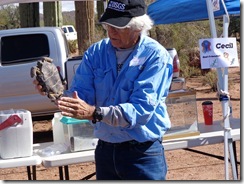 The small lizard was captured in the morning by one of the volunteers, and the tortoise was hatched in his yard about 15 years ago. He explained that he has several tortoises, and the others were deep into their boroughs, and this one was the easiest to catch.

 A King Snake, and a very fascinating talk on who eats who in the desert, and how the King Snake kills Rattlesnakes. The Gila Monster is one that Cecil has had since 1986, and he tied up a harness around it, to set it into the sun to get it more comfortable. Cecil allowed the audience to touch the skin, to feel the different textures from the top and underside scales. The Gila Monster feeds on eggs in nests, and on little animals that are too young to get out of the way. The Gila Monster is too slow to catch anything that moves quickly.
 Steve and I took the walk/lecture with Allan Morgan, about How To Photograph The Desert. Allan Morgan, when introduced to the group, was credited with being a Professional Nature Photographer having worked for the Desert Museum, and has been published in the National Geographic Magazine.
 This is a view of the Ironwood Forest with Ragged Top Mountain in the distance.
 A part of the crowd around Cecil and his interesting talks. The weather was warm enough for most all of us to stay until the end of the programs, and speakers like Cecil kept interest high.
We came home exhausted, mentally from information overload, and physically from being on our feet and walking all day, but it was a great time, and we look forward to other events like this.
A part of the crowd around Cecil and his interesting talks. The weather was warm enough for most all of us to stay until the end of the programs, and speakers like Cecil kept interest high.
We came home exhausted, mentally from information overload, and physically from being on our feet and walking all day, but it was a great time, and we look forward to other events like this.
Friday the weather cooled down to 80, and Steve and I went on a walk to the Multi Armed Saguaro. The walk is somewhere over 5 miles long, and my GPS said 4.8 but Steve's said 5.7 miles in length. I think that I have a setting to change on the GPS, because it consistently shows a shorter mileage than any other GPS that is carried by our hiking group.

 The Multi Armed Saguaro is starting to look a little weathered, but it still is standing strong. I found a new Cholla cactus, and Steve called it a Pencil Cholla, this seems to be a very localized plant.
 The wide view show how sparse the plants are and the openness of the desert floor. It’s interesting how just a few hundred feet away from the RV Park, the terrain turns a bit lonely.
 We found a abandoned mine shaft, and the Pima County folks have fenced it off, for the safety of visitors like us. Steve tossed a rock into it, and the pause until the sound of it hitting bottom, made us think that it is 20 or so feet to the bottom. This area has numerous mining attempts, that were left over from the late 1800s, and none did well.
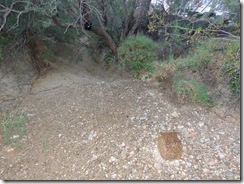 The trail camera (upper center) is working at watching this seed block, and it seems to be a deterrent to visits from the wandering Javelina group. Several nights ago, Steve had a group visit his RV site, and they pushed around a few things on his patio, and left slobber marks on some of the furniture. No Javelina visits since the camera is on guard.

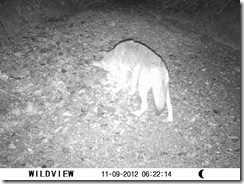 A coyote made a visit to the seed block in the dark hours. This coyote made two visits several minutes apart, and seems pretty interested in the smell and taste. I have the date set incorrectly on the camera, and this set of pictures was taken on 11-10-12.
Yesterday was another day of moving rocks around the patio area of our RV site. I have the depression at the Palo Verde tree lined with gravel, and I believe that there isn’t any hidey holes for rattlesnakes or packrats. The snakes and packrats aren’t a real threat, but I don’t like surprises, the snakes will leave if given the opportunity (they don’t like us either), and the packrats can cause damage to a RV if they find a way into the underside, or wall, because they chew on anything like wires or plastic plumbing lines. As the weather cools down at night, our chances of finding a rattlesnake are really reduced, as they hide out and stay dormant till the spring when it gets warm again.
I have the trail camera setup again this year, and to help with activity, I have bought a seed block. The seed block is kind of like a salt block for cows, I remember those in the North West States, but the seed block is bird seed pressed into a big brick with molasses to keep it together.

 The first night with the camera, I only caught a bunny. The date and time are shown on the pictures, and this bunny was active when it was still dark.

 This morning I walked into the wash to exchange the memory card in the camera, and there wasn’t a fresh track of anything on the ground. We had rain last night, and the ground was smoothed over, and no evidence of any activity, except for a little more rounding of the corners of the block. I had 150 pictures recorded, and it was all quail and bunnies. Some pictures were one bird, then two or more, or a bunny or two, and these pictures show the bunnies and some quail sharing the seed block.
Steve’s bird feeder area is only about 100 feet from the wash, and during Happy Hour we enjoy watching the birds and bunnies come in to feed, and the bunnies share with quail and doves all of the time. I guess that they both know that neither is a threat to the other.
This morning I walked into the wash to exchange the memory card in the camera, and there wasn’t a fresh track of anything on the ground. We had rain last night, and the ground was smoothed over, and no evidence of any activity, except for a little more rounding of the corners of the block. I had 150 pictures recorded, and it was all quail and bunnies. Some pictures were one bird, then two or more, or a bunny or two, and these pictures show the bunnies and some quail sharing the seed block.
Steve’s bird feeder area is only about 100 feet from the wash, and during Happy Hour we enjoy watching the birds and bunnies come in to feed, and the bunnies share with quail and doves all of the time. I guess that they both know that neither is a threat to the other.

 These two wide pictures are of the weather this morning. We have been here a week, and this is the first storm to pass through. We got some serious sprinkles last night, but not quite a hard rain, and I hope that the dust is washed off of the gravel that I have raked all over our RV Site. Yesterday, I bought some beer from the local Nimbus Brewery here in Tucson, and it needs some ice today, I think that I’ll get a sack of ice to cool it.
Anne-Marie and I have been working on making our RV site an easier place to walk around. We have bought a couple of bird feeders, and bird seed, and even a new porch rug, our old one wasn’t worth saving for another season. The weather has been hot since our arrival, and Anne-Marie has had the air-conditioning on in the afternoon, and it’s now cooling down for a few days.
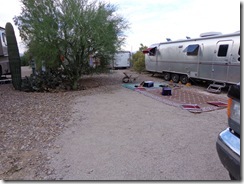 This is our front yard, with nothing set up. I used the wheelbarrow to move the lighter colored gravel around, and it really makes a difference once the fist sized rocks were covered up. The tree is a Palo Verde, and the bark is green. The tree is situated in a depression, and this is from when the park was being leveled, and this saved the tree during construction. A cactus has been growing at the base of the tree and has spread about and now the depression has been home to packrats and a few rattlesnakes. To eliminate the hidey holes for the critters, I have been clearing out the depression, and when done, I will dump gravel around the depression, and smooth the rocks over the the exposed dirt. This work should be finished later today, and the remaining bird feeders filled and hung.
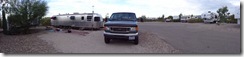 Our friend Linda, asked where we were parked, and this picture should show our house in relation to the other RVs in the cul-de-sac. We are only one space over from where we were for the last three winters.
 Yesterday we went on a walk in the desert. This is a small pause at the graves of Bill and Ole Shep, with Steve, Maria, Jeanne, and Anne-Marie. Our walk was a little over two miles and we crossed into several small washes, and it was amazing to see the amount of gravel and sand that was moved around. Some small washes had all the sand removed, and others filled to the brim with flood waters and scoured the desert floor out on the flat. Maria told us that the rain was so hard, and the flooding in the washes was so high during this time, that she was unable to get home from work for 1 1/2 hours, till the flooding receded.
I bought a seed block, from the feed store, and I set it out in a in a wash along with the trail camera, yesterday. The javelina had visited Steve’s RV the night before, and I hope to get some pictures of them at the seed block.
Yesterday we went on a walk in the desert. This is a small pause at the graves of Bill and Ole Shep, with Steve, Maria, Jeanne, and Anne-Marie. Our walk was a little over two miles and we crossed into several small washes, and it was amazing to see the amount of gravel and sand that was moved around. Some small washes had all the sand removed, and others filled to the brim with flood waters and scoured the desert floor out on the flat. Maria told us that the rain was so hard, and the flooding in the washes was so high during this time, that she was unable to get home from work for 1 1/2 hours, till the flooding receded.
I bought a seed block, from the feed store, and I set it out in a in a wash along with the trail camera, yesterday. The javelina had visited Steve’s RV the night before, and I hope to get some pictures of them at the seed block.
Saturday we arrived in Tucson, and we are getting settled in. Anne-Marie and I checked out the available sites in the park, and we were looking at moving across the cul-de-sac and next door to Steve, but Anne-Marie just couldn’t find the ideal spot for the trailer. We even were considering pulling our trailer in head first, and this would give us a desert view from the front room, and that would be great, but the utilities would have to wrap around the trailer and attach to the hookups right near where our front door would be, (only the sewer would be objectionable).
 Anne-Marie choose the site that was right next door to our old site, from last year. Mark and Maria had moved into our old site after we left for the traveling season last spring, and Doc the park owner, was wanting them to move before we returned. I didn’t have an emotional attachment to our old space, and Doc was told, we will use a different one for the season. We are making progress on the new site, and I have raked the small gravel around, and it looks like we will have a very large patio area. We have bird feeders, and we are working on having a good viewing area, while not making a home for unwanted pests (packrats). It looks like I will have to clean out some cactus at the base of our Palo Verde tree, to eliminate hiding holes for snakes and rats.
 We have a new finch feeder, and already they have found it.
 One of the park residents found a clay pot ring in the desert, while on a walk right next to the RV Park. There were some severe rain storms this last summer, and the water uncovered this next to the trail.
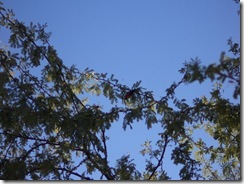
 Grandma Johnson’s house is for sale, and Anne-Marie’s washer and drier are still there, and these pictures were taken on a laundry day. On a walk, I found a tree that was in bloom, but the flowers were small and green, and didn’t show up at all. The bugs were all over this tree, bees, butterflies, wasps, and lots of different pollen gathering flies. What attracted my attention the most was the tarantula hawks, and I wasn’t able to get a close up picture of any of them, but these pictures show two different exposures of these large wasps. These are large black wasps that get up to 2 inches long, and they make a noise similar to a grasshopper when flying.

 There were a lot of these butterflies on the tree, and they were a lot of fun to watch. As I stood close by this tree, I could see hundreds of these fluttering about, feeding on the tree.
Yesterday we traveled into Arizona and we spent the night in Wickenburg, Arizona. Anne-Marie didn’t have a good nights sleep, the night before, and I got to drive the entire trip. I didn’t have the energy to drive continuously through, and about lunch time, when I suggested to Anne-Marie that she take the wheel, she suggested pulling over and taking a nap. An hours nap and somewhat recharged energy levels got us to Wickenburg.
We haven’t seen much wildlife since we passed through Vegas on our drive to Laughlin, except for a rattle snake that was crossing the road in front of us. The snake was nearly 30 inches long, and was slowly moving across our lane of travel, and was stretched out straight, almost like a stick in the road. We were traveling down the two lane highway just after the last pass and on a steep downhill grade. I saw the snake just as it was too late to do anything to avoid it, and the drivers front tire ran over the snake. I looked in the mirror, to see if it was hurt, and I think that the trailer tires may have hit it also, and it was obvious that it didn’t like being run over, because it was now in a split second, a twisting about and then it was out of sight. We were traveling 50+ mph and I had to keep the van on course and we don’t know if it was hurt. I remember when I was a kid, one of my Moms friends told a story of running over snakes in the road, and she claimed that you had to skid the tires on the snake to kill it, so maybe this one will have survived to do its job on the other side of the highway.
We traveled yesterday, and again today we will travel. Tucson is now only a days drive away, and I am looking towards a few days of decompression before any new adventures.
The last two days have been travel days for us. Tuesday, we left Carson City, and headed east to reach the most direct highway south to Tonopah Nevada.
Anne-Marie and our Brother-in Law Ernie had discussed a shortcut that takes 20 miles or more off of this route, and it sounded like we would look for it again on this trip. Anne-Marie and I looked for the route before, and just gave up and continued on the main highway, but this trip we looked for the valley that should hold the shortcut, and we found it.
Anne-Marie and I both remember the word Churchill being involved in the route, or something that made us think of Churchill. As we traveled east on the Highway, at about 15 miles out of town, off to the right about 3 miles distance, was a valley heading off in the likely direction of the shortcut. A quick look at the GPS in the van, and the name of the road just coming up was Road 2B, Fort Churchill Road. A quick turn and we were started on our shortcut, and a fairly new paved road to boot. The paved road was an access road for a adjoining housing development, and I looked at the GPS, and it indicated that we were on a lessor not paved road, but it isn’t always accurate in these matters. A few hundred yards after the houses, the pavement stopped just before the cattle guard at a fence crossing the road. The cattle guard alone in this area of the country isn’t alarming as they are even on state highways, at times, but this was a bit different. The nice paved road narrowed down to a near single lane gravel road that was bordered on each side by old barbed wire fencing, with the occasional “No Trespassing” signs. The road looked to be very passable, and the gravel road was level looking, but unseen from a distance was that it was a bit wash boarded. As we drove on the dusty road, the wash boarding became worse and then bad, in places the road looked to be a cross between a riffle and a rapid in a river, in a few places the waves in the road were almost 24 inches from peak to peak, and what looked to be 10 inches deep. I found myself trying to dodge the high spots, almost climbing up out of the road grade that had been eroded down below the level of the field. We had slowed to a crawl, and after some encouragement from Anne-Marie to look for a place to turn around, I continued about a half mile ahead to a farm house. Not a good place to try to turn the trailer around, the wide areas had been used by farm equipment, and none were made for a low clearance trailer like ours. I checked the GPS, and followed the road on out, and a branch road headed back to the paved highway, just a few more miles up the road, or we could continue on for 13 more miles of gravel road, and come out at Fort Churchill State Historic Park. We were moving at a crawl, almost getting up to 11 mph at times. We reached the branch road, and it went up a hillside, not too steep, but not better, so we continued on the gravel road.
 The gravel road followed the Carson River Valley, and the cottonwood trees were yellow and golden colored. This picture is at a wide area of the road, and the wash boarding was not too severe in this section.
 Just inside the State Park, we came upon this sign, Pony Express Trail 1860-1861.
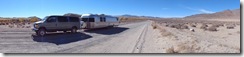 This is the road we just traveled, and it looks good in this view, but back behind us, the road hasn’t seen a road grader since this spring.
I looked at my mapping program on the computer Tuesday evening and found that the road has several names, Fort Churchill Road, Hwy 2B, and The California Emigrant Trail. I measured the shortcut and it is shown as 16 miles long vs. 26 miles to stay on the state highway, and it took us about an extra hour to travel.
We arrived in Tonopah for the evening, and Anne-Marie found that the silverware was rearranged in the drawer, there was tumbled things about in the spice cabinet, and the salt grinder had unscrewed itself and scattered its parts in the cabinet.
This is the road we just traveled, and it looks good in this view, but back behind us, the road hasn’t seen a road grader since this spring.
I looked at my mapping program on the computer Tuesday evening and found that the road has several names, Fort Churchill Road, Hwy 2B, and The California Emigrant Trail. I measured the shortcut and it is shown as 16 miles long vs. 26 miles to stay on the state highway, and it took us about an extra hour to travel.
We arrived in Tonopah for the evening, and Anne-Marie found that the silverware was rearranged in the drawer, there was tumbled things about in the spice cabinet, and the salt grinder had unscrewed itself and scattered its parts in the cabinet.

 Tonopah is a old mining community, and the skyline still has the old mine structures. The lobby of the Tonopah Station Hotel, Casino, RV Park.
Tonopah seems to have lost its antenna TV stations, there is a cable TV company, but the RV Park doesn’t subscribe to it. Last year we had TV service with the antenna, but not a channel this visit. With no TV and slow internet, we were in bed at 8:00PM.
Yesterday was a travel day, again. We drove through Pahrump, and skirted the southern edge of Las Vegas on our trip south, and ended our travel day here at Laughlin Nevada. Anne-Marie counted 15 burros during the drive. Tomorrow will be a travel day, and we hope to arrive in Tucson on Saturday.
Tonopah is a old mining community, and the skyline still has the old mine structures. The lobby of the Tonopah Station Hotel, Casino, RV Park.
Tonopah seems to have lost its antenna TV stations, there is a cable TV company, but the RV Park doesn’t subscribe to it. Last year we had TV service with the antenna, but not a channel this visit. With no TV and slow internet, we were in bed at 8:00PM.
Yesterday was a travel day, again. We drove through Pahrump, and skirted the southern edge of Las Vegas on our trip south, and ended our travel day here at Laughlin Nevada. Anne-Marie counted 15 burros during the drive. Tomorrow will be a travel day, and we hope to arrive in Tucson on Saturday.


